The One Page Most Interior Designers Leave Out of Their Proposals
Here's the revised post:
The One Page Most Interior Designers Leave Out of Their Proposals
By Leona Coe | Coe Design Studio | Interior Design Business Tips
You have spent hours on a proposal. The scope is clear, the fee is well-structured, and the story is compelling. You hit send and then you wait.
Sometimes the client comes back quickly. More often, there is silence. Days pass and you start to wonder whether they received it, whether they are comparing you with someone else, whether the fee was too high. You send a polite follow-up. More silence.
Here is something worth considering: what was the last page of your submission?
Your Client Is Not Just Thinking About Your Proposal
When a prospective client receives your document, they are not sitting in a quiet office reading every word with focused attention. They are a homeowner who also has a full-time job, a family, and seventeen other things on their to-do list. Or they are a developer managing multiple consultants across multiple projects. Or they are a couple navigating different priorities and schedules, trying to find time to sit down together and make a decision.
Your proposal lands in an inbox that already has 40 unread messages. It gets opened on a phone between meetings, forwarded to a partner who has not seen anything yet, flagged to read later - and later keeps moving.
This is not a reflection of their interest in your work. It is just life. And the designers who understand this do not take it personally - instead, they remove the friction.
The Cognitive Load Problem
Cognitive load is the mental effort required to process information and make a decision. When that load is high - when someone has to figure out what to do next, who does what, and by when - they default to inaction. Not because they do not want to proceed, but because the path forward feels unclear, and unclear feels like effort, and effort loses to everything else already competing for their attention.
The single most effective thing you can do at the end of a proposal is eliminate that ambiguity entirely - not with a vague "please do not hesitate to reach out if you have any questions," but with a concrete, simple, three-step next steps page that tells the client exactly what happens from here, including who is responsible for each action and when.
What a Next Steps Page Actually Does
A next steps page does several things simultaneously, none of which require more than half a page of content:
It signals professionalism - a designer who has thought through the engagement process inspires more confidence than one who leaves the path forward undefined
It reduces decision fatigue - instead of the client having to figure out how to proceed, you have already done that thinking for them
It creates forward momentum - a clear step one is far easier to act on than a general invitation to "get in touch"
It sets the tone for how the project will be run - if your next steps page is clear and organised, the client infers that your project management will be too
None of this requires more words. It requires better structure.
The Three-Step Format
Keep it to three steps, which is enough to cover the full journey from receiving the proposal to having the project booked and confirmed. More than three starts to feel like a process document rather than a clear invitation to proceed.
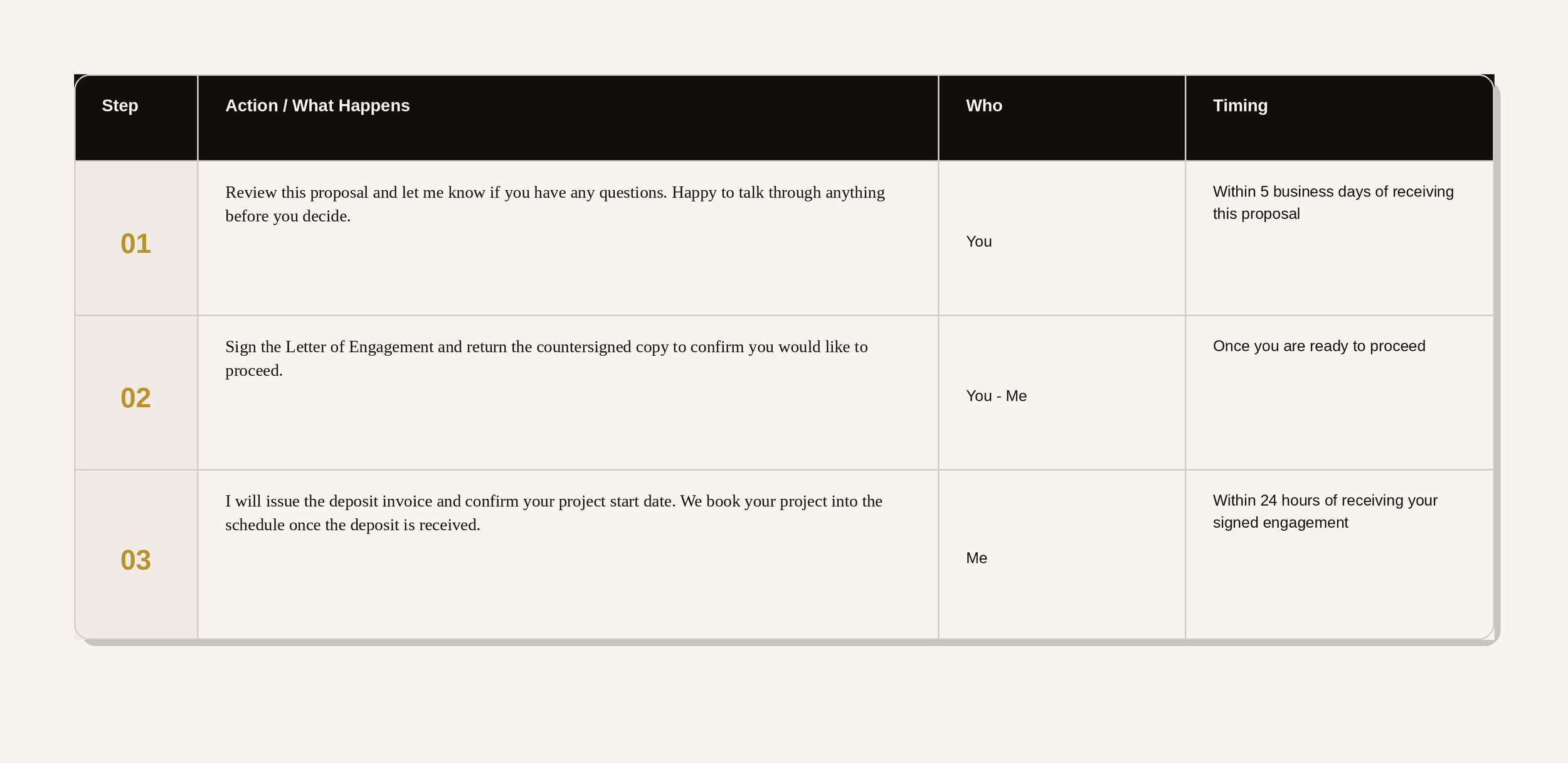
Each step should have three things: what happens, who does it, and when. That is it, no paragraphs, no caveats. A table works perfectly because it is scannable in seconds, which matters when your client is reading on a phone between school pick-up and dinner.
Here is what that looks like in practice:
Make it stand out
Whatever it is, the way you tell your story online can make all the difference.
That is the whole page - three rows, four columns, less than 80 words. A client reading this in 30 seconds knows exactly what to do, knows you will handle the rest, and has a clear sense of the timeline. The decision to proceed has been made as easy as it possibly can be.
Why the "Owner" Column Matters
Notice that each step names who is responsible, and this is not bureaucratic - it is considerate. It tells the client that you are not expecting them to figure out the logistics. Steps one and two are on them (review, sign). Step three is on you. That division of labour reassures the client that once they take the small actions required, you take it from there.
It also subtly reinforces accountability without pressure. The client can see that the ball is in their court for step one, which means when they have not responded in five days, you have a natural, non-awkward reason to follow up: "Just checking whether you had a chance to review - happy to answer any questions before you decide." The next steps page has already framed that follow-up as helpful rather than chasing.
Why the Timing Column Matters
The timing column does two things. First, it gives the client a gentle internal deadline - five business days to review feels reasonable and specific without feeling pressured. Second, it shows that your practice has structure. When you say "I will confirm your start date within 24 hours of receiving your signed engagement," you are demonstrating that you run an organised business, and that is reassuring to a client who is about to hand over a significant sum of money.
Keep the timing realistic and specific. Do not promise 24-hour turnarounds you cannot deliver, and do not use "within a few days" as a substitute for an actual timeframe - that is vagueness dressed up as flexibility.
Where It Goes in the Proposal
The next steps page is the last page of the proposal, not an afterthought tucked into the footer. It sits as the final substantive section, with its own heading, treated with the same visual weight as everything before it.
After your fee summary and your terms overview, the last thing the client reads before closing the document is a clear, calm, simple set of instructions for how to move forward. That is the impression they carry when they put the proposal down and go back to their day - not uncertainty, not effort, just three clear steps.
A Note on Tone
The next steps page should not read like a legal notice. It is not a demand, it is a service. Write it in plain, warm language - the same voice you use in person - because you are making it easy for them, and that generosity of thought is worth something and it comes through in how you write it.
Avoid phrases like "please be advised" or "upon execution of the agreement." Use "once you are ready to proceed" and "I will take it from there." The difference in tone is significant - one feels transactional, the other feels like a professional you want to work with.
The Bigger Principle
The next steps page is a small thing - half a page, one table, three rows. But it reflects a much bigger principle, which is that the best client experience is not the most elaborate one. It is the one that requires the least effort from the client at every decision point.
Interior designers who understand this stop designing proposals that impress and start designing proposals that convert. The former is about the designer, the latter is about the client. Your proposal has already shown them your expertise - the next steps page shows them your judgment.
Add It to Your Proposal Template Today
If you are using a proposal template, or want one, the Client Proposal Story Framework includes a next steps page as the final section. It is pre-formatted with the three-step table structure, editable owner and timing fields, and the same design system used across the full Coe Design Studio template bundle.
The Client Proposal Story Framework is available for $12 AUD at coedesignstudio.com.au, or as part of the 10-template Business Bundle for $47 AUD.